Multifidelity POD

Proper Orthogonal Decomposition Surrogate for Rarefied Gas Dynamics

Python PyTorch Reduced-Order Modeling LBM
[ FIGURES PENDING PUBLICATION ] Simulation visualizations will be posted upon formal publication in Physics of Fluids.

Coarse-to-Fine Resolution Mapping with 8× Speedup

Coarse In,
Fine Out

Running high-resolution LBM simulations of rarefied gas transport is expensive: a $1024 \times 1024$ grid can take 10+ minutes to converge. The Proper Orthogonal Decomposition Mapping Method (PODMM) learns a multifidelity mapping from cheap coarse ($256 \times 256$) snapshots to the expensive fine ($1024 \times 1024$) steady-state solution.

Trained on paired coarse/fine snapshots via SVD, PODMM is non-intrusive, requires no modification to the underlying solver, and reduces the total computational cost by up to 8×.
Key Results

  • Avg. Rel. Error (synthetic): 6.3%
  • Speedup (synthetic):
  • Error (Mowry shale): 15%
  • Speedup (Mowry shale): 3.4×
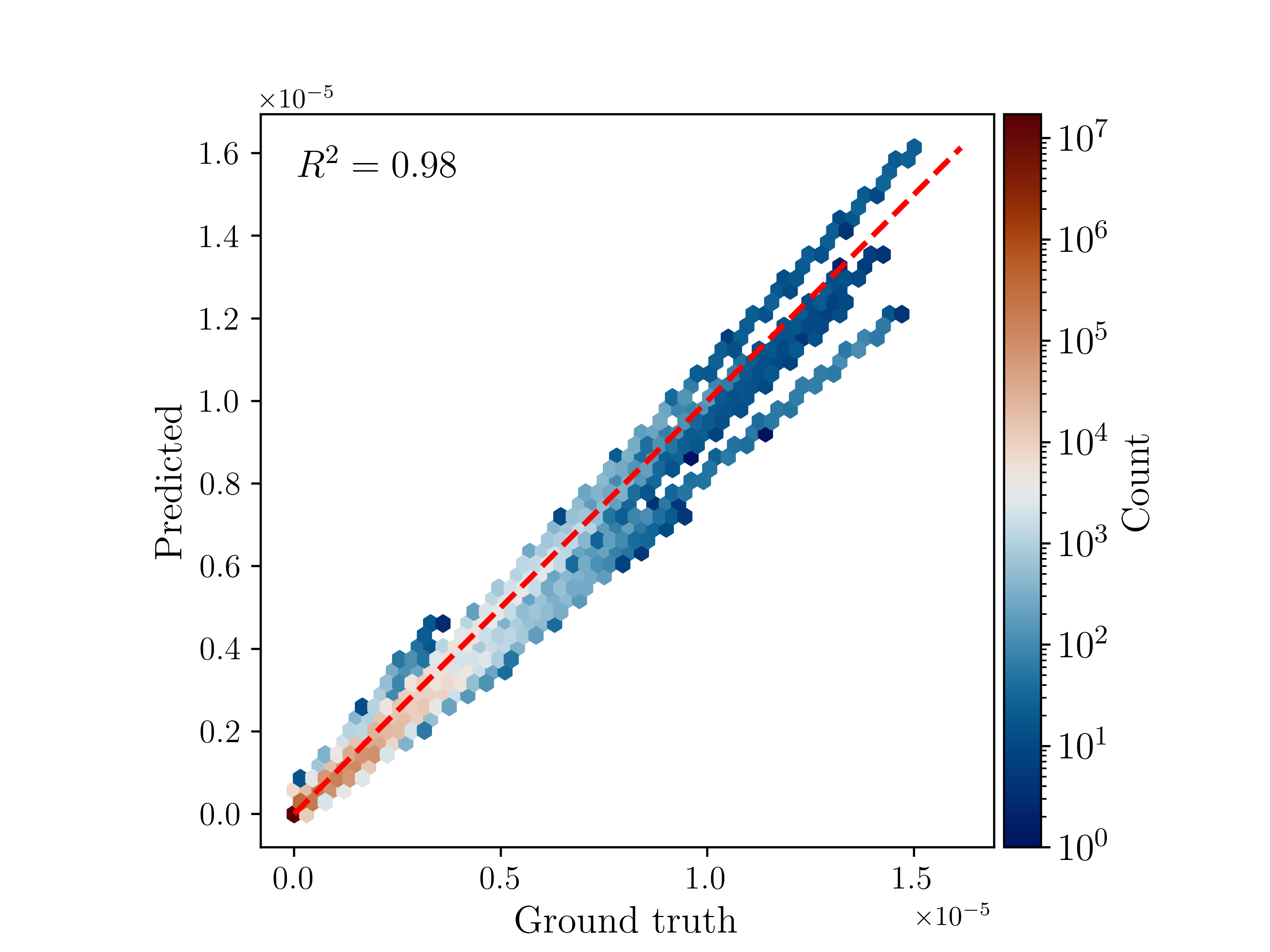
  • $R^2$ (Mowry shale): ≥ 0.98

01. Methodology

The PODMM Framework

PODMM stacks paired coarse ($\mathbf{g}$) and fine ($\mathbf{f}$) snapshot matrices into a joint matrix $W^{\mathrm{PODMM}}$ and performs a Singular Value Decomposition. The resulting shared POD basis $U_M$ is partitioned into fine-resolution modes $\zeta_f$ and coarse-resolution modes $\zeta_g$:

At prediction time, a new coarse snapshot $\mathbf{g}_t$ is projected onto $\zeta_g$ to find reduced coordinates $\boldsymbol{\alpha}_t$, then the same coordinates reconstruct the fine-resolution prediction via $\zeta_f$:

The operator is provably BIBO stable and Lipschitz continuous — bounded inputs always yield bounded outputs.

02. Synthetic Training Cases
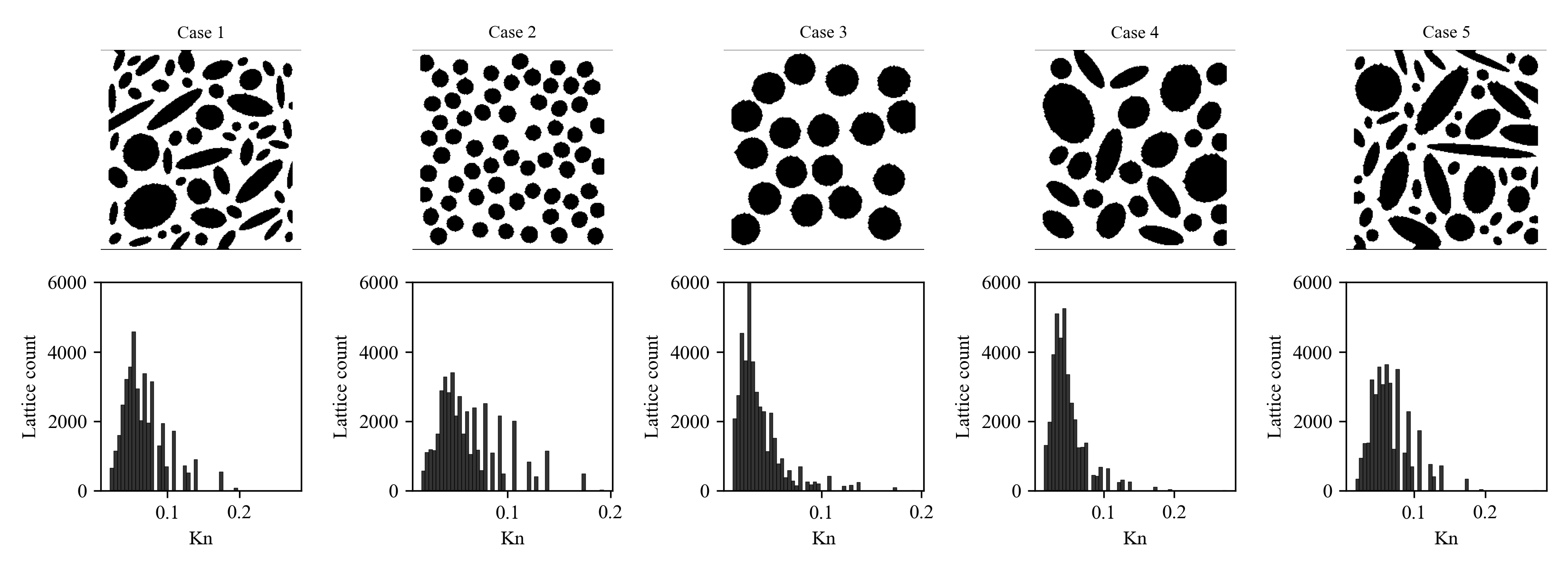
[ PORE GEOMETRY FIGURES ] Available upon publication in Physics of Fluids.

Coarse → Fine: 4× Resolution

Five pore geometries were constructed on $256 \times 256$ (coarse) and $1024 \times 1024$ (fine) grids at 1 nm and 0.25 nm pixel resolution, respectively. The methane mean free path at $2\,\mathrm{MPa}$ and $300\,\mathrm{K}$ gives local Knudsen numbers spanning 0.02–0.2.

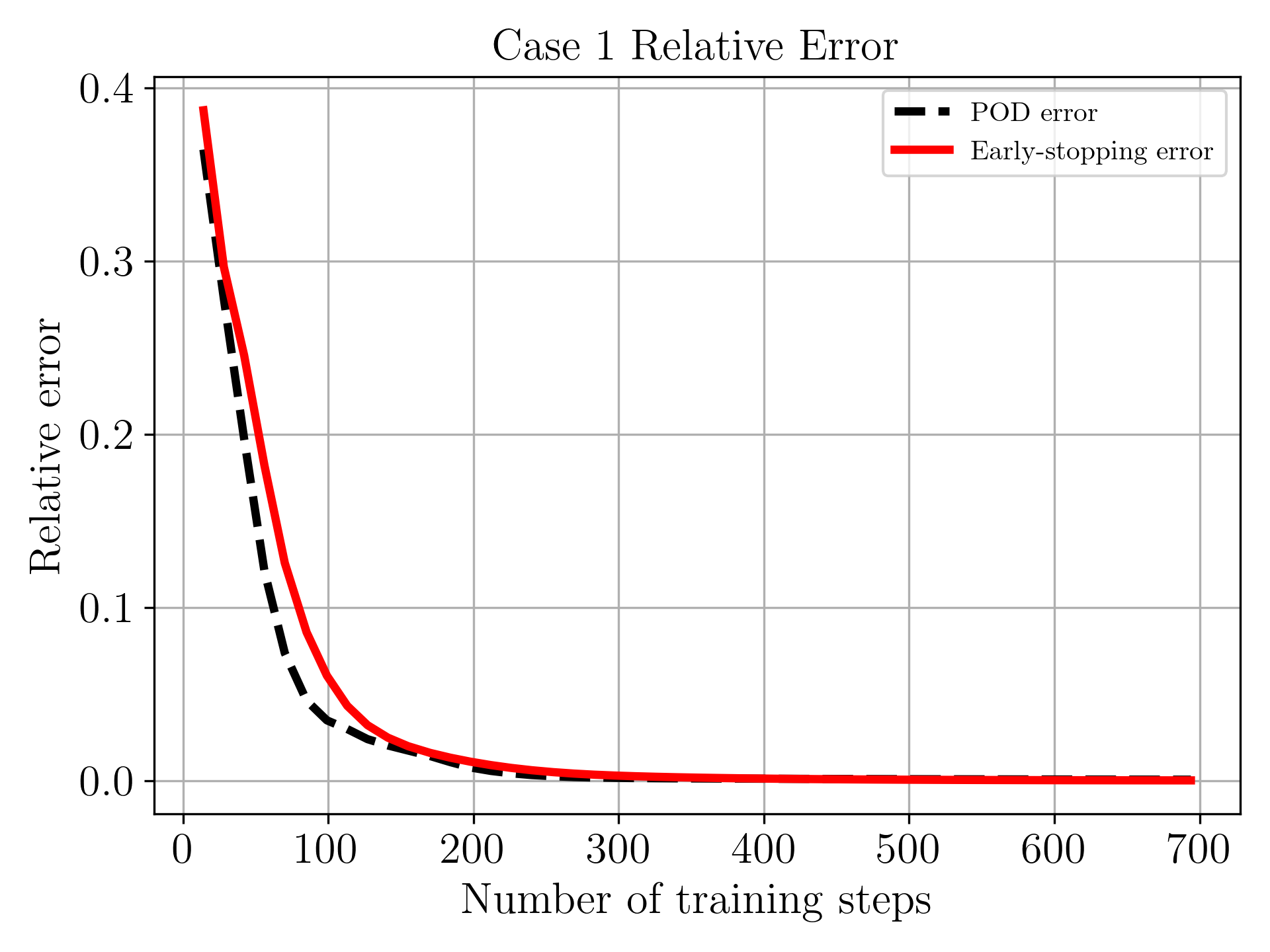
PODMM is trained on only 10% of available snapshots for most cases. Using coarse velocity fields as input, it predicts the fine-resolution converged velocity field — without ever running the expensive fine simulation to completion.

Coarse grid256 × 256
Fine grid1024 × 1024
Res. ratio
Training data10% of snaps
03. Results
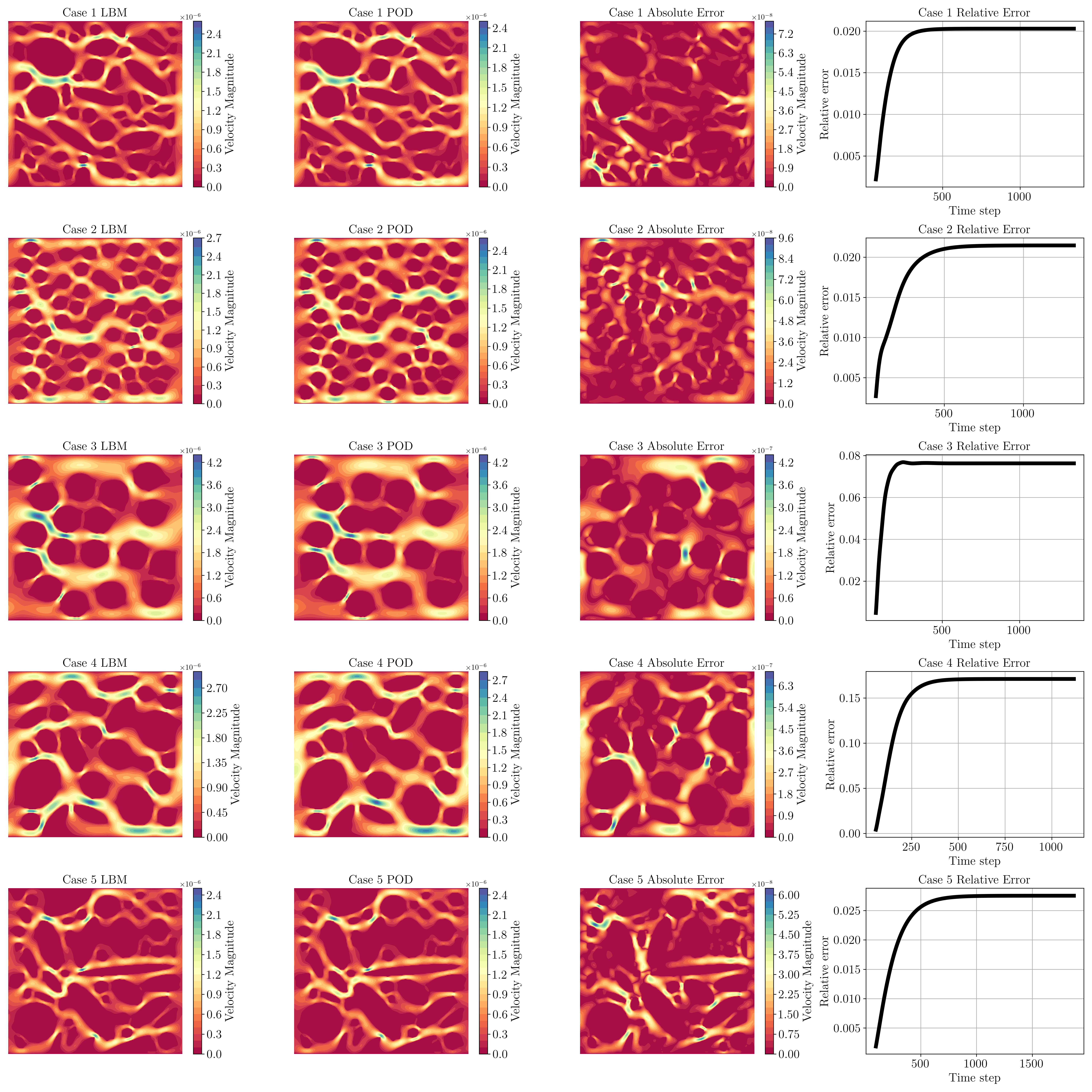
[ VELOCITY FIELD COMPARISON FIGURES ] LBM ground truth · PODMM prediction · absolute error — available upon publication.
Case Relative Error (%) Mean (%) Median (%)
11.946.292.64
22.13
37.62
417.11
52.64
04. Real-World Validation: Mowry Shale

From Synthetic to Real Rock

A scanning electron microscopy (SEM) image of Mowry shale — a formation of major interest for natural gas and CO₂ storage in Wyoming — was binarized and used to generate a $6142 \times 6142$ fine-resolution LBM simulation with 2.8 million active lattice nodes.

The full fine-resolution simulation requires ~41 hours of CPU time. PODMM, trained on 30% of coarse snapshots, predicts the final state in under one minute — achieving a 3.4× total speedup with only 15% relative error and $R^2 \approx 0.98$.

Fine grid6142 × 6142
Active nodes2.8 million
LBM wall-time~41 hours
PODMM total~12 hours
[ MOWRY SHALE RESULTS ] Prediction vs. LBM and error evolution — available upon publication.

Publication

Application of Multifidelity Proper Orthogonal Decomposition-Based Surrogate Models to Rarefied Gas Dynamics

Kitterman, A., Rustamov, N., Liu, Y., & Aryana, S. A.

Paper accepted by Physics of Fluids and is in preparation for publication.


← Back to Projects