WyoPop

Rural Population Mobility Prediction via Spectral Graph Neural Networks

Python PyTorch Graph Neural Networks Spectral Methods
WyoPop inflow and outflow prediction scatter plots

Seven Years of Wyoming Mobility — Predicted Over a 2-Year Horizon

Rural Mobility
at CBG Scale

Most mobility models are calibrated on dense urban environments. WyoPop addresses the critical gap for sparse, rural mobility networks by analyzing seven years of anonymized mobile device movement data (January 2018 – February 2025) across Wyoming's 410 Census Block Groups (CBGs).

A Spectral Graph Neural Network fuses dynamic monthly origin-destination (OD) flow matrices with static socio-demographic and point-of-interest data, processing flows as frequency-domain signals to separate structural patterns from noise.
Key Results

  • Outflow $R^2$ (2-year): 0.96
  • Inflow $R^2$ (2-year): 0.86
  • Outflow avg. error: 19.9%
  • Inflow avg. error: 20.3%
  • Coverage: 410 CBGs, 86 months

01. Data
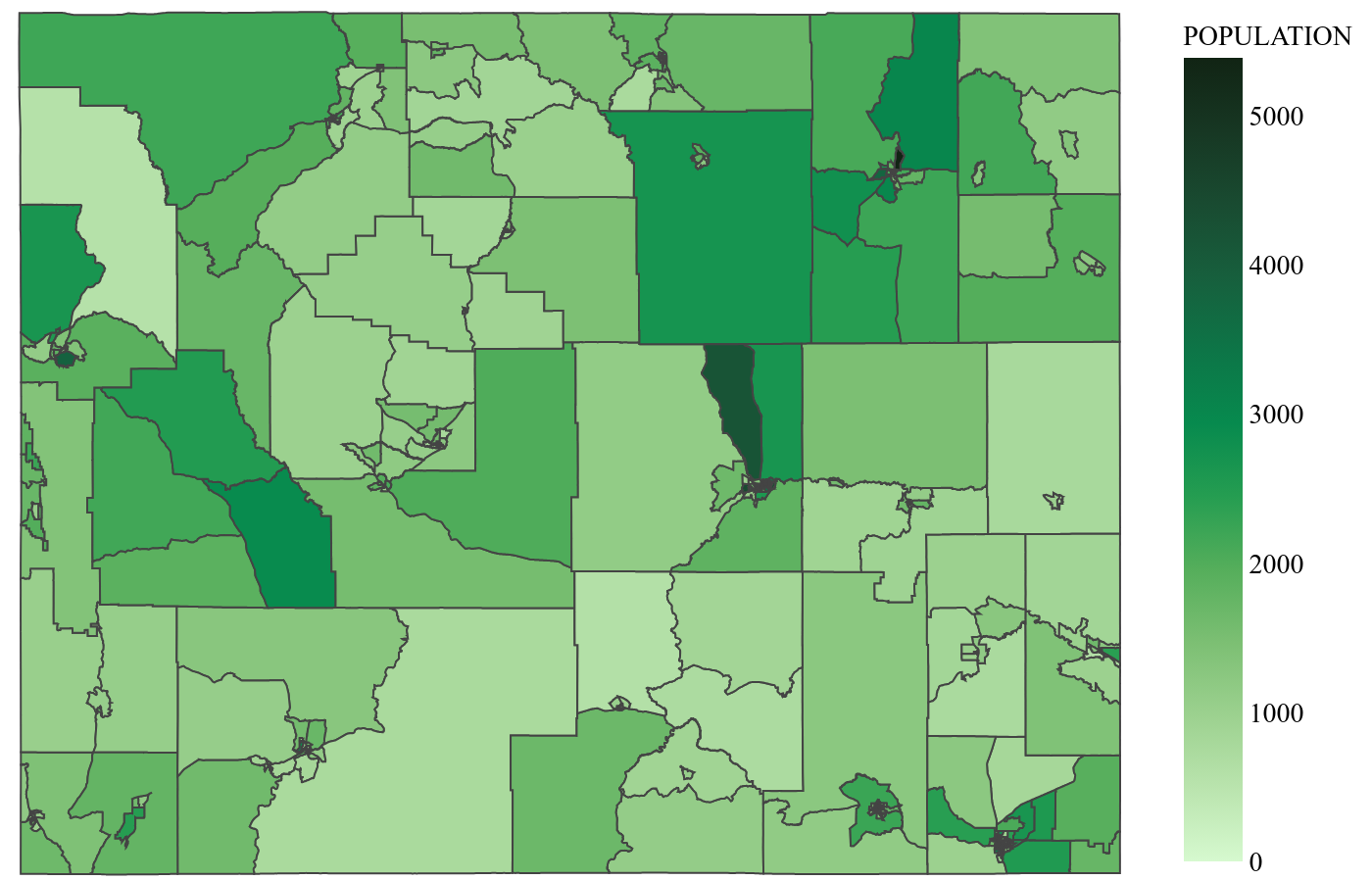
Wyoming population distribution across Census Block Groups

Wyoming population distribution across 410 CBGs

Three Integrated Sources

  • Mobile device OD matrices: Monthly anonymized movement data from January 2018 to February 2025. Each monthly matrix $\mathbf{F}^{(t)} \in \mathbb{R}^{410 \times 410}$ records directed trip counts between all CBG pairs.
  • Socio-demographic data: U.S. Census Bureau variables — income, age, housing, education — for all 410 CBGs.
  • Points of Interest (OSM): Schools, hospitals, parks, industrial sites, etc. Merged with socio-demographic data and compressed to 30 principal components (95% variance).

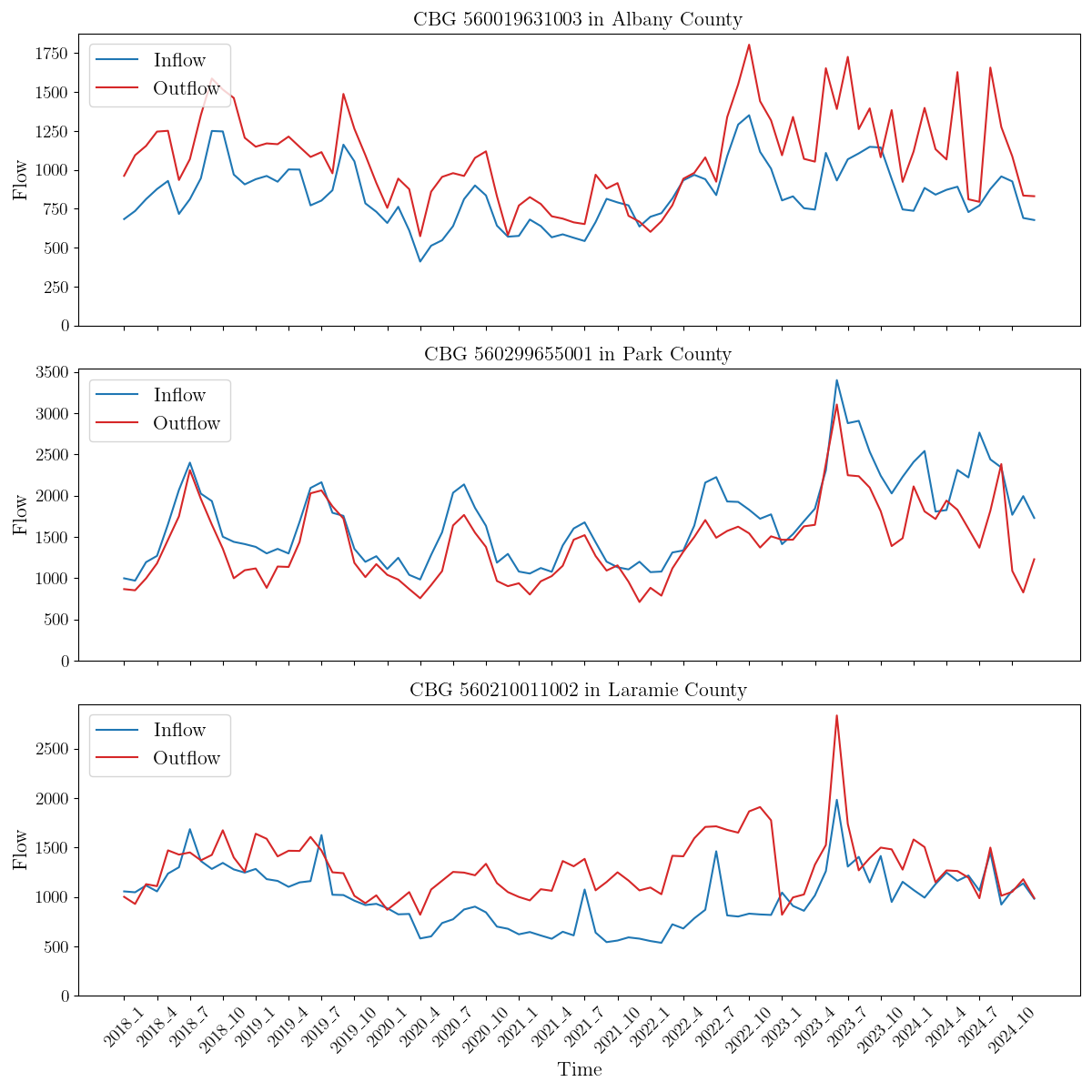
Inflow and outflow for each CBG are computed as column and row sums of the OD matrix:

Sample CBG inflow and outflow time series

Sample CBG inflow and outflow time series showing seasonal patterns and COVID-19 disruption

02. Spectral Graph Neural Network

Frequency-Domain Flow Modeling

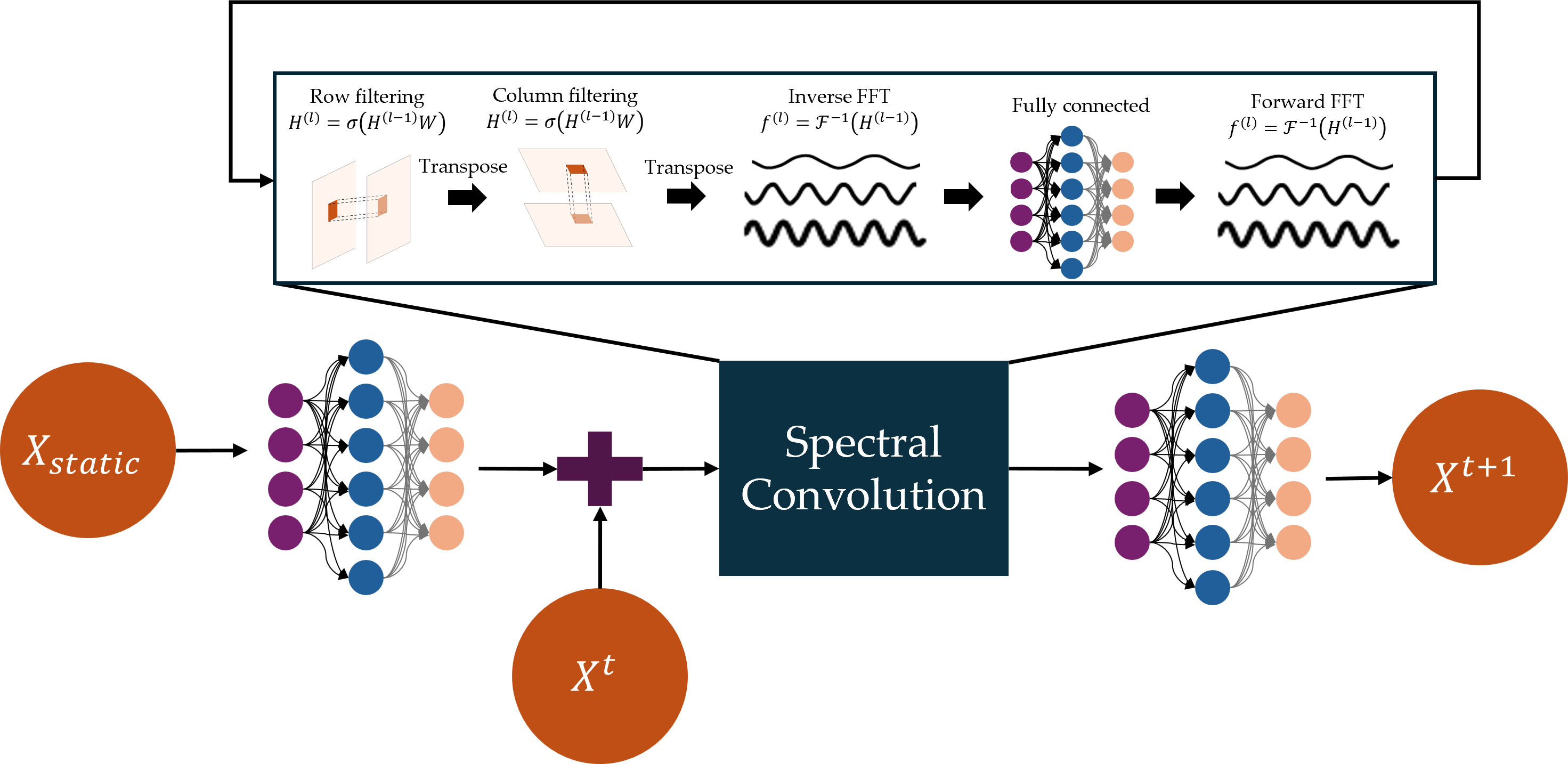
The core insight: OD flow matrices represent flow rates, analogous to frequencies. Rather than treating them as spatial maps, we apply the Inverse Fourier Transform first to decode rate signals into a latent structural state, then apply learned spatial filters, then transform back to the frequency domain.

Static features $\mathbf{X}_{\mathrm{static}} \in \mathbb{R}^{30 \times 410}$ (socio-demographic + POI, PCA-reduced) are embedded and injected additively into the dynamic OD matrix before spectral processing.

A free-running training strategy feeds model predictions back as inputs during training — matching inference-time conditions and improving long-horizon generalization.

Spectral GNN model schematic

Model architecture: static embedding + spectral convolution + decoding

Spectral Convolution via FFT

After fusing static features, row-wise and column-wise spatial filters are applied. The Inverse FFT maps the flow-rate signals into the latent spatial domain, a fully connected layer mixes channels, and the FFT returns to the frequency domain for a final learned kernel:

Convolution in the spatial domain ≡ element-wise multiplication in the frequency domain.

03. Forecasting Results
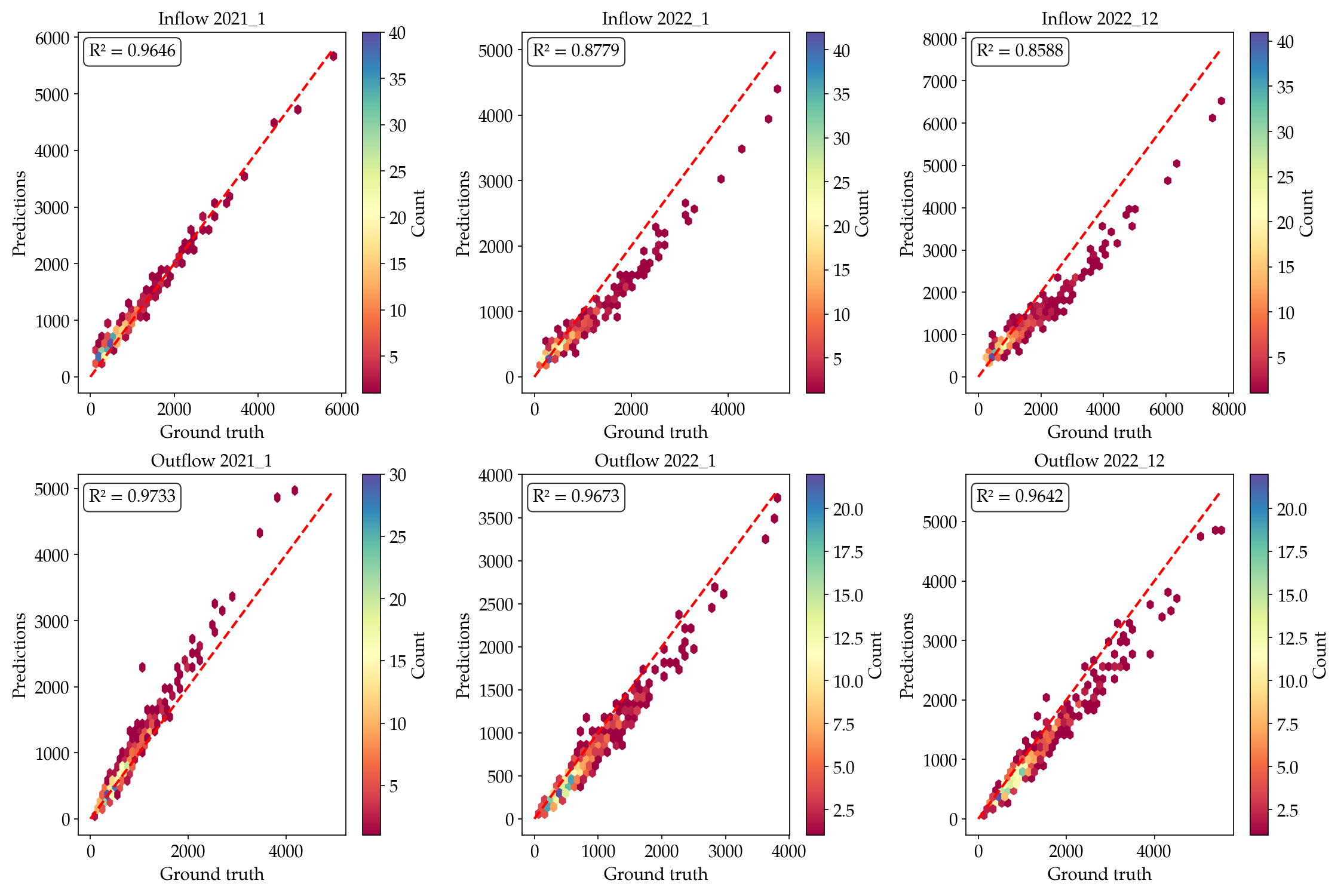
Recursive inflow and outflow prediction scatter plots at 3 forecast horizons

Inflow (top) and outflow (bottom) predictions at Jan 2021, Jan 2022, and Dec 2022 across all 410 CBGs

Recursive 2-Year Forecast

The model is trained on 36 months (2018–2020) and generates recursive predictions through December 2022 — feeding each predicted OD matrix as the next input without ground-truth feedback.

  • Jan 2021: Outflow $R^2 = 0.97$, Inflow $R^2 = 0.96$
  • Jan 2022: Outflow $R^2 = 0.97$, Inflow $R^2 = 0.88$
  • Dec 2022: Outflow $R^2 = 0.96$, Inflow $R^2 = 0.86$

Key Findings

  • Outflow > Inflow predictability: Origin-based mobility is more structurally stable than destination-based inflow.
  • Post-COVID regime shift: A structural change in mobility norms limits transferability to 2023–2024.
  • Topological dichotomy: Error increases with degree centrality (urban hubs) but decreases with betweenness centrality (rural connectors).

Publication

Rural Population Mobility Prediction Using Dynamic Graph Neural Networks: A Wyoming Case Study

Rustamov, N. & Xu, C.

Paper currently under review at Engineering Applications of Artificial Intelligence.

Read Preprint on SSRN →

The preprint version of this paper is hosted on SSRN and is subject to SSRN's Terms of Use. Figures and content reproduced on this page are from that preprint. Authors retain copyright; redistribution or reuse of figures without permission is not permitted.


← Back to Projects